
Directional boring for plumbing contractors
A directional bore takes a water service line under the driveway, the sidewalk or the mature landscaping, so your crew skips the hand-digging and the tear-out.
Request a quote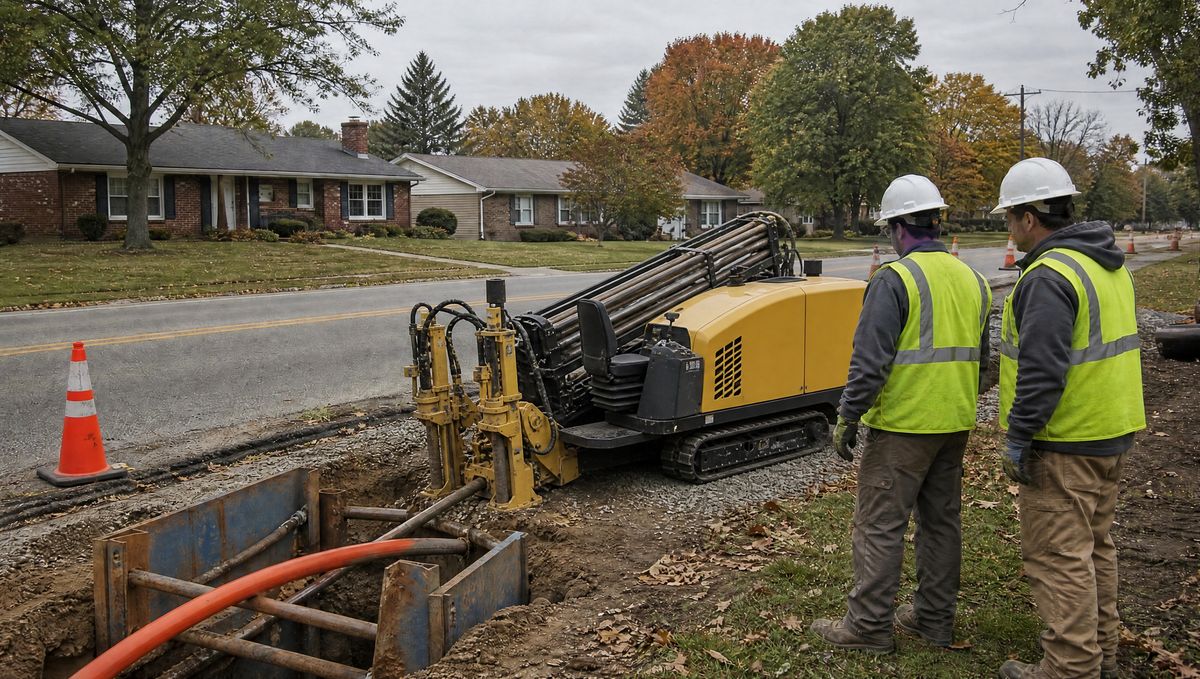
What we bore
- Water service replacements
- Water line reroutes
- Frozen or broken lines
- Long-distance service pulls
- Hard to access properties
- Crossings under driveways, sidewalks and mature landscaping
Why plumbers use us
- No hand-digging
- No trenching
- No tear-out
- No delays
How a bore goes
Send the address and scope
Tell us the line size, the distance and the route you prefer, and which water utility serves the address. A photo of the meter location helps.
We handle locates and planning
We call 811, walk the route and check for private lines that 811 does not mark. Where a crossing is close to the path, vacuum excavation exposes it so the bore stays clear.
Directional bore completed
A small entry pit and an exit pit, a steered pilot hole, then a reamer to open it to the size your pipe needs. [to confirm: the largest pipe size and bore length Warwood runs for water services]
You pull and connect your line
Your crew ties the pipe to the reamer and connects it at the meter pit and the building, and we coordinate the timing with you. [to confirm: whether Warwood's crew or the plumber's crew pulls the pipe]
Final restoration and cleanup
We fill the pits, put the turf back and leave the lawn, drive and sidewalk as we found them.
What to send us
Start with the line type, the distance and the preferred route. That is enough for us to confirm coverage the same day and plan the bore.
Indiana law requires a notice to 811 at least two full working days before any dig, and boring counts as digging. A ticket stays good for 20 days. Indiana 811 does not mark private lines such as sprinklers, landscape lighting, pool lines or lines to a shed, so have those located before the rig arrives.
- The service address and the line you are replacing or adding
- The distance from the main or the old meter to the building
- Where the new meter pit or entry point will sit
- Gates, fences and pets, so the crew can reach both ends of the bore
- The pipe standard your water utility requires, if you know it
Details
Pipe and sizes
Water utilities set their own pipe standards, so check the one that serves your job. In the Citizens Energy Group service area, which includes Marion County and Westfield, a complete service replacement from the main to the meter pit uses SDR 9 polyethylene pipe with tracing wire, and PEX and PVC are not allowed. Citizens sizes a house service at 3/4 inch for a home under 2,000 square feet with no irrigation and 1 inch for a larger home or one with irrigation.
Other utilities and municipal systems may allow different materials. Ask for the standard before you order pipe, and we will plan the bore around it.
Depth, length and ground
Mini-scale directional drilling commonly places pipe up to about 12 inches across at depths to about 15 feet, over distances of hundreds of feet. Our bores run from 10 feet to 300 feet. A house service is usually tens to a few hundred feet.
The rig enters the ground at a shallow angle. At a 12 degree entry, reaching 4 feet of depth takes about 19 feet of horizontal run, which is why the entry end needs clear space.
Central Indiana sits on glacial till, a mix of clay, gravel, cobbles and the occasional boulder. Clay holds a hole well. Cobbles can push a bit off line, and sand below the water table is hard to keep open. When the ground turns hard we change tooling, shorten the bore or recommend an open trench for part of the path.
Permits and who does what
Utilities usually require a licensed contractor who is bonded with them, and a plumber's permit before the work. In Marion County, Citizens requires a bond of $25,000 on file and inspects the meter pit before it makes the tap. A bore under a public road or inside a right-of-way needs the county or city right-of-way permit.
Indiana licenses plumbers at the state level, and the plumbing work inside the building is a licensed plumber's work. [to confirm: how Warwood's scope is defined for private water service lines and whether a plumbing license applies]
What the lawn looks like afterward
Boring avoids the trench, so the damage is limited to the entry pit, the exit pit and the meter pit, plus drilling fluid at each end. A clean job contains the slurry, hauls it off and restores the turf. If a sprinkler head sits near the path, mark it before the work starts.
Questions
Do you call 811, and do I need to?
We handle the locates for the bore. Indiana law requires two full working days of notice for any dig, and a ticket is good for 20 days. Indiana 811 does not mark private lines, so line up a private locate for sprinklers, lighting and pool lines.
What pipe goes in?
Whatever your water utility requires. In the Citizens Energy Group area a complete service replacement uses SDR 9 polyethylene with tracing wire. Other utilities can differ, so check before you order.
How big should the service be?
The utility sets the minimum. Citizens uses 3/4 inch for a home under 2,000 square feet without irrigation and 1 inch otherwise. Commercial and fire lines are designed by an engineer.
Who owns which part of the line?
In the Citizens area the utility maintains the main, the tap and the pipe out to the public right-of-way line. The customer maintains the pipe from that line to the building and the meter pit. Other utilities draw the line elsewhere, so ask yours.
Can you replace a frozen or broken line without trenching?
Often yes. A new line can run on a new path while the old one is abandoned. The path has to clear other utilities and the entry and exit need open space. Send the address and we will tell you.
How long does a bore take?
A short house service is often a day or less once the locates are in. The paperwork and the utility inspection usually set the schedule. [to confirm: Warwood's typical time for a residential water service bore]
What if there are rocks or a high water table?
We can change tooling, shorten the bore or open-cut part of the route. We will say so before we start.
Will you tear up the driveway or the lawn?
No trench crosses the drive or the walk. You will see an entry pit, an exit pit and a meter pit, and some muddy ground at each end until we restore it.