
Directional boring for electricians
We bore the conduit path under the drive, the lawn or the parking lot, and your crew pulls the conductors into a clean, protected run.
Request a quote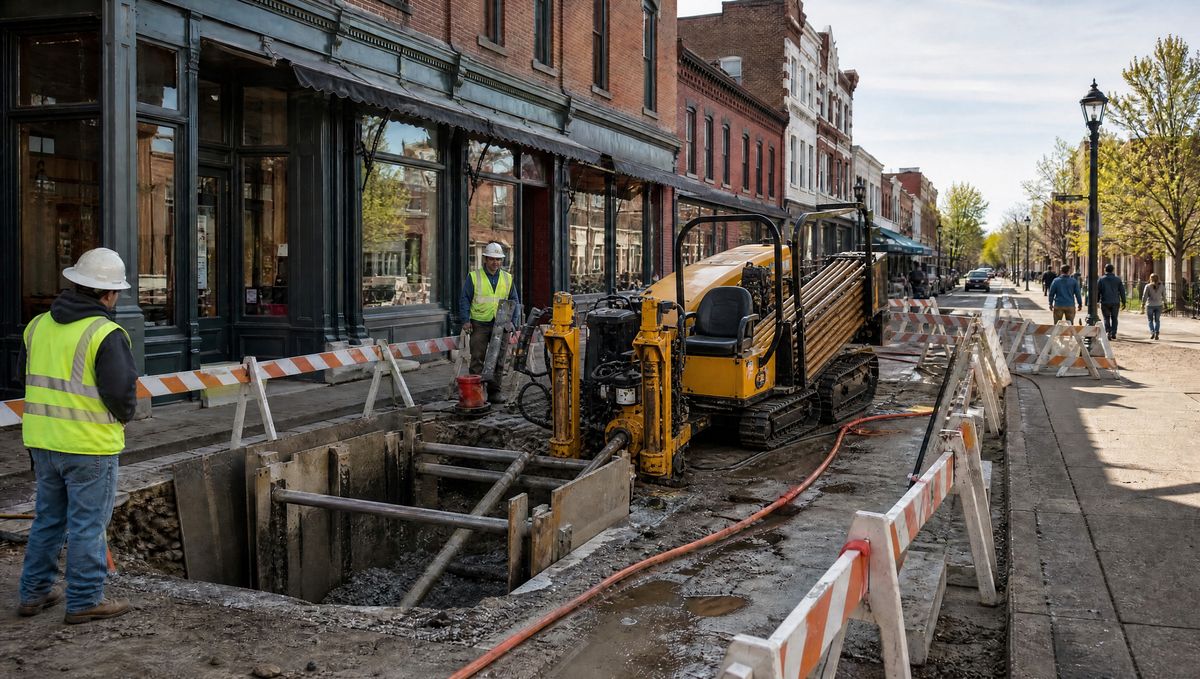
What we bore
- Residential service upgrades
- Detached structures (garages, sheds, outbuildings)
- EV charging runs
- New construction electrical feeds
- Landscape lighting
- Commercial service drops
Your electrical installs stay
- Neat
- Protected
- Code-compliant
How a bore goes
Send the address and scope
Give us the run's start and end points, the conduit size and count, and the distance. Tell us what the load is, such as a garage panel, an EV charger or a commercial service drop.
We handle locates and planning
We place the 811 ticket, check for private lines and mark a route that keeps clear of other utilities. Where a live line is close, good practice is to expose it by hand or by vacuum excavation before the bit gets near it.
Directional bore completed
A tracked pilot bore, then a reamer sized for the conduit. A pull string is left in the run. [to confirm: the largest conduit size and the longest run Warwood bores for electrical work]
You pull and connect your line
Your electrician pulls the conductors and makes the connections, and we coordinate the timing so the conduit is ready when the crew arrives. [to confirm: whether Warwood ever pulls conductors, and whether it holds any electrical license]
Final restoration and cleanup
The pits are filled, the turf is back and the ends are capped and left where your crew can find them.
What to send us
Start with the run's endpoints, the conduit you plan to use and the distance. That tells us whether the bore fits our rigs and what the path has to avoid.
Call 811 at least two full working days before the bore, which Indiana law treats as a dig. The ticket lasts 20 days, and marks that weather or traffic wipe out have to be renewed. 811 members mark only their own lines, so lines to a shed, a pool or landscape lighting need a private locate.
- The start and end points, with the building or pole at each
- The conduit type and size, and how many runs share the path
- The service entrance or panel location
- The utility's service application, if one is required for the job
- Staked corners, a cleared route and a place for the entry pit
Details
Conduit and sizes
Solid-wall HDPE conduit is made for pulling by directional drilling, and polyethylene is the pipe most often pulled this way. Schedule 40 and Schedule 80 PVC are also used. What a given utility or inspector accepts is their call, so confirm before the pipe is ordered.
The electric utility in Indianapolis, AES Indiana, publishes a customer-installed service conduit spec: gray 4 inch Schedule 40 PVC with long sweeping bends, a pull string and enough cover to the top of the pipe. Plumbing fittings and flex pipe are not accepted. That document is written for trench work, so ask the utility's designer whether bored conduit is acceptable. [to confirm: which electric utilities in Warwood's area have accepted bored conduit]
Depth, length and bends
Cover depth depends on where the conduit runs and how it is protected. The electrical code sets different minimums for ordinary ground, for driveways and parking lots, and for roads, and the version your inspector enforces governs. Your electrician's plan is the authority here, and we bore to the depth it calls for.
Residential and small commercial runs are commonly tens to a few hundred feet, and our bores run from 10 feet to 300 feet. Utilities also limit the number of bends between pull points, so we plan the path with long radius sweeps and place pull boxes where the plan needs them.
Permits and licensing
Electrical licensing is local in Indiana. Indianapolis, for one, requires an electrical contractor license for anyone who installs or alters a system that distributes electrical power. Pulling conductors and connecting them is the electrician's work.
Any bore that crosses a public road or runs through a right-of-way also needs a permit from the county or the city. State highways need a state permit with its own review time, so plan for the lead time.
Working near live lines
Rig makers' safety guidelines for drilling near buried electric call for a strike detection system that is set up and tested each shift. When the bit may come within about 10 feet of buried electric, the operator wears insulated boots, insulated gloves are within reach, and nobody touches the rig while it drills. [to confirm: whether Warwood's rigs carry a strike detection system, and its own rules for working near buried electric]
Questions
Do you pull the wire?
Your electrician does that. We place the conduit and leave a pull string so the conductors go in cleanly. [to confirm: Warwood's scope for pulling conductors]
What conduit and how deep?
We follow your electrician's plan and the utility's spec. In AES Indiana territory the posted service spec is 4 inch Schedule 40 PVC with long sweeps and enough cover to the top of the pipe. The electrical code sets minimums that change with location and wiring method.
Can you bore under a driveway to my garage or shop?
Yes, and it is one of the most common uses. Cover rules are stricter under driveways, parking lots and roads, and we plan the depth for them.
Do I need 811 if I know where my own lines are?
Yes. The law requires a ticket for any dig, and your own private lines are not marked by 811, so locate them too.
Will my utility accept bored conduit?
Ask the utility's designer before the design is final, since written specs are often for trench work. AES Indiana, Duke Energy and the rural cooperatives each have their own manuals.
How far can you go in one bore?
We bore anywhere from 10 feet to 300 feet. The practical limit depends on the conduit size, the bends, the soil and the pulling tension.
What about EV charger runs?
A charger run to a garage or a post is a short bore under the lawn or the drive. The conduit goes in with a pull string, and your electrician sizes it for the charger and any later upgrade.
How do you handle live lines nearby?
Locates first, then hand or vacuum exposure at crossings, tracking during the bore, and a strike detection system on the rig where one is fitted. [to confirm: Warwood's own procedure near live electric]