
Fiber, telecom and low-voltage boring
One call covers the conduit path under the drive, the lawn or the parking lot, and your crew pulls or blows the cable when the pathway is ready.
Request a quote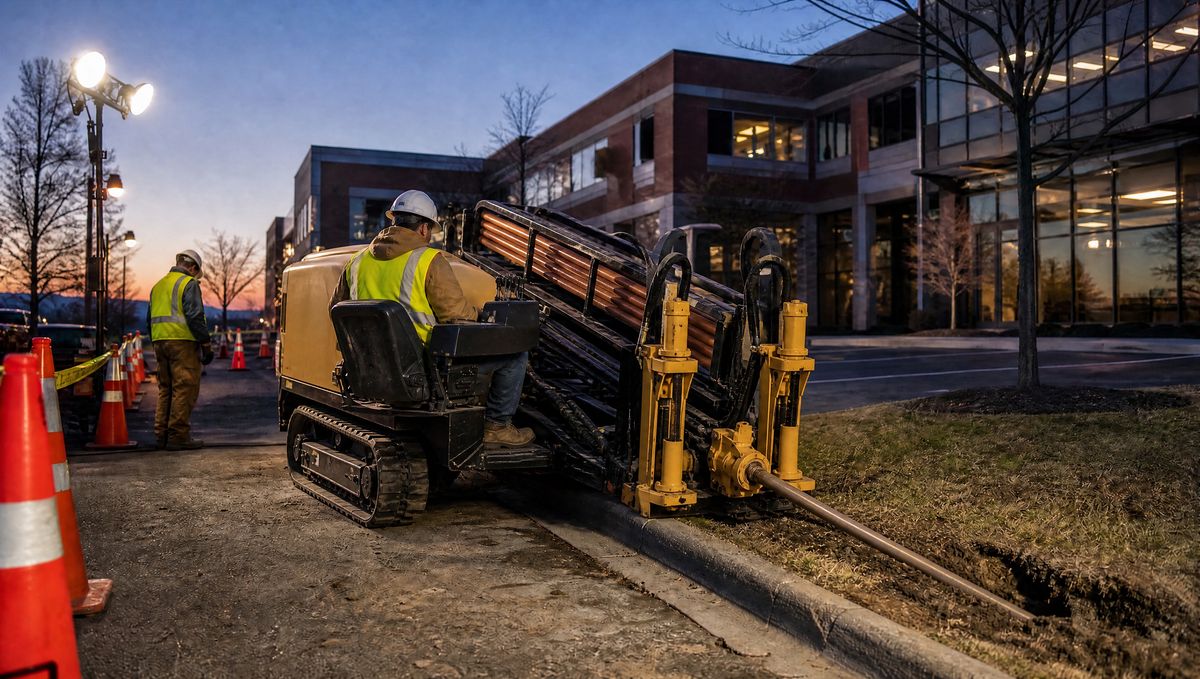
What we bore
- Fiber-to-home
- Telecom lines
- Camera systems
- Gate access
- Smart home networks
- Commercial low-voltage installations
Ideal for contractors who want
- One call solves it
How a bore goes
Send the address and scope
Tell us the cable type, the route, the distance and how many conduits the run needs. Say who supplies the conduit and who pulls the cable, and whether an electrician is working the same site.
We handle locates and planning
We place the 811 ticket and set up a private locate for the lines 811 members do not mark. Fiber and coax are not metal, so crossings get exposed by vacuum excavation before the bit reaches them.
Directional bore completed
A tracked pilot bore, a reamer sized for the duct, and a pull string or tape left inside. Both ends are capped so slurry and water stay out. [to confirm: the conduit and duct types and sizes Warwood carries, and its largest bore diameter for communications work]
You pull and connect your line
Your crew pulls or blows the cable, makes the connections and tests the link. We coordinate the timing so the pathway is proofed and ready. [to confirm: whether Warwood ever pulls, blows or tests cable, or places the pathway only]
Final restoration and cleanup
The pits are filled and the turf is back. Good practice is to photograph both conduit ends and record the depth along the route, since buried plastic duct is out of sight once the lawn recovers.
What to send us
Start with the address, the cable type, the route and the distance. Camera, network, gate and smart-home runs are private work on the owner's property, so there is usually no right-of-way permit, and 811 members do not mark anyone's private wiring.
Book the 811 ticket at least two full working days before the bore, and plan a private locate for sprinkler, lighting, pool and any older private conduit. Carrier fiber and coax are the lines most often missing from locate paperwork, which is why good practice exposes a crossing instead of trusting the marks alone.
- The cable type and its limits: outside diameter, bend radius and pull tension
- How many conduits the run needs and the size of each
- The start and end points, and where the cable will end inside the building
- The electrician's plan, when power or a gate operator is part of the job
- The carrier's duct specification, when the run is fiber for a provider
Details
Why a bored conduit
A bore leaves the concrete, the asphalt, the pavers and the mature lawn uncut. The conduit also does a job after the install: a duct placed once can be fed again with a higher-count cable years later without a second bore, while direct burial locks the route to the first cable. It protects the cable from crush and from later digging.
The electrical code does not require conduit for fiber. Carrier standards, state highway permits and franchise agreements usually do, so check the spec you are working to before you choose a size.
Conduit, duct and microduct
Continuous HDPE conduit is the usual pull for a bore, with solid-wall sizes of 1-1/4 inch and 2 inch common for fiber, and innerduct or microduct fitted inside a larger duct when a run carries several cables. Schedule 40 and Schedule 80 PVC are used for sleeves and stub-ups. Camera, network and gate runs often use 1 inch to 2 inch conduit so a second cable can be added later.
Leave a pull string or woven pull tape in every conduit and keep the tracer wire where the spec calls for it. Handholes, pull boxes and pedestals are the carrier's design decision. [to confirm: whether Warwood sets handholes, pull boxes or pedestals]
Bends, length and cable limits
Optical fiber is normally limited to a bend radius of about 20 times the cable diameter while it is pulled and 10 times after it is installed. Utilities and standards also limit the number of bends between pull points, so we use long sweeps instead of elbows at both ends.
Twisted-pair data cable has a hard limit of about 100 meters, 328 feet, for a channel. Our longest bore, 300 feet, is right at the edge for copper, so a camera or network run that long usually needs fiber or an extender.
Power stays separate
Do not run line-voltage power and low-voltage control wiring in one conduit. Gate operator makers say to use separate conduits, and the safest layout is one conduit per system with space between them. Find out who the electrician is before the bore starts, because power is often by others and the stub-up locations come from the operator's drawing and the pad layout.
Depth and permits
Depth for communications and low-voltage conduit follows the owner's spec, the carrier's standard and your inspector, and state highway right-of-way calls for 4 feet of cover. Work on private property normally needs no right-of-way permit, and carrier jobs bring their own permits, bonds and traffic control. A local electrical permit can apply when line-voltage power is part of the job. [to confirm: Warwood's typical bore depth under a driveway or lawn and the carriers it has worked for]
Questions
Do you pull or blow the cable, or only place conduit?
We place the bore and the pathway, and your crew pulls or blows the cable. We leave a pull string or tape in the conduit. [to confirm: Warwood's scope for cable work]
What conduit size do I need?
Camera, network and gate control runs often use 1 inch to 2 inch conduit with sweeps, and a larger size leaves room for a second cable. Fiber and carrier work follow the carrier's spec, so ask for it first.
Can power and data share one conduit?
Not line-voltage power with low-voltage control wiring. Use a conduit for each system. Fiber carries no current, but its mechanical limits still apply.
How long a run can you do for a camera?
We take bores from 10 feet up to 300 feet. Twisted-pair Ethernet tops out at about 328 feet, so a long camera run needs fiber or an extender.
Will you leave a pull string and mark the ends?
A pull string or tape is left in the duct, both ends are capped, and good practice is to photograph them and record the depth along the route so the ends can be found after the lawn recovers. [to confirm: whether Warwood leaves a pull string, caps and photographs the ends and records the depth on every job]
How do you protect my existing lines?
Locates first, then vacuum exposure at crossings, and tracking during the bore. Ask the owner for a private locate of sprinkler, lighting, pool and invisible fence lines, which 811 does not mark.
For fiber to the home, will the provider accept a bore I arrange?
That is the provider's call. We place the pathway to the provider's specification, so get the duct size and the stub-out detail from them first. [to confirm: which providers have accepted Warwood's conduit placement]
Will you set the gate conduit where the operator needs it?
We land the bore ends where your installer says, using the operator's drawing and the pad and loop layout, so the stub-ups sit in the right spot.